Sunday, 30 December 2012

Picking our Veg for our Christmas Feast!

This year for our Christmas Feast we decided to use as many vegetables as we could from Helen's Bay Community Garden. Not only were they free, except for the work and effort we put into them, but they also taste that much better because they are so incredibly fresh and were grown in a mineral rich soil. 

On the first few pictures you can see that we're in the polytunnel, harvesting the remains of our fennel crop, some swiss chard and one tiny turnip! 


Now most of the crop had been picked beforehand and there wasn't much left in the polytunnel for christmas, but we will try to be better organized next year and have more things growing in the winter, especially winter greens like spinach and rocket. But at least we had some lovely fennel and swiss chard for our Christmas Duck. And one turnip...
However, in the fields the situation was quite different as there were many brussels sprouts to pick. Brussels Sprouts are incredibly important to us, not just for Christmas and because it's tradition, but more because they're such an amazing vegetable. They're easier to grow than regular cabbages and we find them a lot more versatile to cook with. It's always such a great feeling to pick the fat and glorious sprouts which look like green gems growing on a miniature tree. 
And then at the top of the cane, as the sprouts get smaller, you get these tiny little sprouts which we use like peas and are just so sweet and tasty and look beautiful in every dish. Finally, on the top of the plant you get the crown, a small cabbage or a big brussels sprout, depending on your point of view! We cook this part like cabbage, often slow cooked and with bacon and onions. Hmmm, so good! You can see AC in the picture below holding one of the tops.
Anyway, we think that brussels sprouts should be eaten not only for Christmas, but during the whole period from November to January when they're in season. We always find them such a versatile ingredient, as we use them in curries, ramen soups, Italian pasta dishes....the list could go on and on. They're a very healthy veg too and contain many minerals, and they are great in soups for those health conscious readers among you!
Picking our own veg for our Christmas feast was a real joy, a break from buying presents and seeing relatives, just enjoying ourselves in nature and foraging the fruits of our labour. What more could you want!? And I think we all learned that we should grow more and eat more brussels sprouts, in many different ways, and appreciate them for the great little veggies that they are.


Saturday, 22 December 2012

Oca - The Peruvian Wondercrop

Now here's quite an unusual plant that most of you have never heard of probably, but I think is really worth mentioning, at least to people who are interested in growing veg. Oca is a plant that produces underground tubers, just like potatoes, but it's an incredibly vigorous and resilient plant that isn't really bothered by pests or diseases, unlike potatoes which are often affected. The plant grows similarly to potatoes and the Incas apparently used to grow both crops next to each other, as staple crops for their annual diet. Just like potatoes, Oca stores exceptionally well. But Oca is a far later crop than potatoes, often only ready in late November or early December, depending on local conditions. And Oca are not too fond of early frosts, they need the dark light levels of late autumn to produce their tubers and the longer you wait the fatter your Oca gets. You should really harvest them 1-2 weeks after the first frosts have hit the plants. It's quite extraordinary really, when the first frost hits the plant the lush green foliage of the plants starts wilting and dying down immediately. That's when the remaining energy of the plant 
is used to fatten the Oca.

As you can see on the picture to the left, Oca plants form very effective ground cover. The picture was taken at Helen's Bay Community Garden, and the three tires in front of the raised beds contain Oca plants. The tire on the left shows an Oca plant in its early stages and the other two are in intermediate stages. The plant produces a lot of foliage over its lifetime and produces many small flowers. It's really a non-fuss plant to grow and it stays happy during its entire cycle. Oca tubers are normally chitted like potatoes before planting, meaning that the tubers are taken out of their dark storage in March/April and put into daylight so that new growing buds can form well. Oca Tubers should be planted at the latest in April because the plants profit from a long growing season, and if you want to use the plants as ground cover in especially weedy patches of your garden or allotment then it makes sense to get them in the ground as soon as possible. 

And this what the actual thing looks like when uprooted. The variety we planted this year are scarlet and white and when pulled out of the ground are incredibly dark red, or scarlet. As with potatoes, it's incredibly satisfying to dig up Oca, it's like finding hidden treasure in the ground. It really gets you excited like a kid, and our harvest was quite plentiful so there are plenty of tubers to dig up when grown properly. What's also unusual with Oca is that unlike potatoes, they can be eaten raw. Actually it seems that the whole plant is edible and in the Andes the tender leaves and young shoots of the plant are eaten as greens. And what makes them so nice I find is their timing. Because potatoes are a summer/autumn crop depending on your variety and where you live, I love the fact that Oca is harvested in late autumn and early winter. That's probably a reason why they were so important in the Inca crop rotation. And even though Oca can be very much prepared and cooked like potatoes, they really shouldn't be used as a replacement to potatoes. They are two completely different crops, and actually they are very nice combined in a dish, such as a gratin. 

They do become quite pale though when cooked and lose much of their brilliant colour. Below on the left you can see an Oca tuber when sliced in half, and as you can tell they are not incredibly huge. Now they won't grow that much bigger than that and so are not like spuds which can get absolutely ginormous! So Oca tubers stay quite small, and when cooked have a very interesting taste and consistency. They are very creamy, like a mash almost, or a combination between a potato mash and a radish puree. And the taste when cooked goes into the direction of potato, but steers off slightly through its tangy, almost sorrel like flavour. This tangy or slightly sour flavour is also present when eaten raw. I vividly remember the first Oca I tasted, and it was quite different. They do taste slightly odd at first, especially when tasted unadulterated. They are really a combination of flavours, of known flavours, but also slightly unknown. You can't really put your thumb on it. Indeed most people give slightly different descriptions of the flavour. Oca is very crunchy raw, just like a nice crisp radish, and the first flavours are almost opposing. There is that sweetness which comes from the colourful middle, that almost tastes like fruit or strawberries in my opinion (most people differ on what fruit it's supposed to be). But simoltaneously there is a savoury flavour, almost salty in a way, but not really. A deep savoury flavour is the best I can describe it as. And then there is the tangy or sorrel like aftertaste. All in all this may not sound appealing, but it's well worth trying as it is one of the more unusual taste experiences you will have in your life!

But this oddness of flavour is transformed into refreshing crunch and delicate flavour when Oca is used in a salad or is dressed nicely in whatever way you fancy. A bit of acidity and some nice oil, and also  a bit of spice, gives the humble Oca a fancy makeover and thus becomes a welcome change to the usual winter diet of hearty stews and roasted vegetables. That is really one of the reasons why I welcome Oca so much, because it is so crunchy and refreshing at that time of the year and lends itself perfectly to salads. It's also a very healthy vegetable when cooked raw as it is an important source of vitamin C, potassium and iron. So no wonder that Oca is still a crop that many subsistance farmers in the Andes rely on.


Although this account of the humble Oca has been quite long and in full detail, I think it is well deserved because it is such an unusual food, very interesting in flavour both cooked and raw, very attractive looking indeed, very healthy to eat too and a joy to grow in the garden! What more could you want?! And the festive colour of the Oca also works for Christmas...perhaps at some point it will become the new seasonal food. Forget pomegranate, forget brussel sprouts, just eat Oca!

If you want to know where to get hold of Oca tubers for planting then the realseed catalogue is the place to go! They also offer more information on planting etc.


Saturday, 1 December 2012

Perfect Breakfast Rolls, ready in time for breakfast!

Here's our latest bread video, and we really like this one. Everybody likes good warm breakfast rolls in the morning, but a lot of people think that you would have to get up at 4 in the morning to make them for breakfast! Well with our technique it will only take you 30 minutes to get your rolls ready for breakfast, and if you have an oven that you can set for a certain time then it will really only take you 10 minutes in the morning! For fresh breakfast rolls! I think that's pretty good. The trick is really to do all your prep the night before. So the dough is prepared, mixed, kneaded, risen and then you shape your rolls and coat them in a variety of seeds that you like. Then you just cover them with a kitchen towel and put them in the fridge to double in size overnight. Now this is really only possible because we've prepared the dough properly and because we're using good quality white bread flour. White bread flour reacts very quickly to yeast, and even though you're normally recommended to let your bread dough rise in a warm environment it's ok to leave the rolls in the fridge overnight. The yeast reaction doesn't stop in the fridge, it's just very slow, but steady and thus ready in the morning. Now we haven't tried this recipe with other types of bread flour, like wholemeal etc, but I suspect that it will work to a certain degree but not as well as the white bread flour. We this technique is really a winner and possible for everybody! It's simple enough and not too much work, and if you can't try it during the week, it will surely be an amazing recipe for a lazy weekend breakfast or brunch. So do give these rolls a go and we hope you enjoy the video :)


Thursday, 29 November 2012

Swiss Chard and Goats Cheese Quiche (using Soy Cream)

Yup it's time for another seasonal recipe, and this time we're focusing on beautiful Swiss Chard. Swiss Chard comes in different colours and looks absolutely incredible. It's also incredibly tasty, very much like spinach, but even better in my book. It's also very easy to grow and is a nice source of fresh greens at this time of the year. It brings colour, texture and freshness to the winter diet and it's very good used in a quiche. And quiches are so very easy to make, the pastry of course can be bought in most supermarkets and then you can choose whatever seasonal ingredients are available, and we often also use leftovers in it. Even though a quiche is normally made with ordinary cream, we're using Soy Cream for this recipe. One reason being that I myself have a cow's milk intolerance, so I can't use ordinary creeam that often. But I do love a good quiche and was looking for a cream substitute and have used Alpro Soy Cream for this recipe, which is very versatile, easy to use and it keeps very long in the fridge. The texture of this quiche is a bit more eggy, you could only use 2 instead of 3 eggs if you prefer your quiche being creamy. All in all it's a very easy and versatile recipe, perfect for customising. And do consider using soy cream, as it is perfect for people who are lactose intolerant and such, but it's just a nice ingredient in general.

Thanks for watching!!!


Saturday, 24 November 2012

European Week for Waste Reduction in Belfast


AC and I were part of Root & Branch Organic's commitment to waste reduction this Thursday, as part of the European Week for Waste Reduction. We set up a stall in the Black Box in Belfast and offered organic smoothies made with 'waste products' from Helen's Bay Organic Gardens.Pretty much every food business produces waste, and even though Helen's Bay Organic Gardens compost their waste it is of course nicer when perfectly edible produce is eaten and apprecitaed by people. The smoothies were really delicious and it's such an easy thing to do with over-ripe fruit and veg. All in all the event was really fun, we had lots of delicious 'waste' food and we met many interesting people!
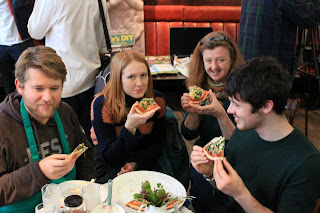

The big message however should really be that we all should take a moment and think how we can reduce waste, especially at home. We met two people from Belfast City Council and had a really interesting talk about waste managment. Whether you might think or not, Belfast City Council like many other councils are actually very keen for people to recycle more. Not only is it better for the environment and local waste reduction helps meet European standards, but there is also a huge difference in cost between getting rid of normal waste or recycled waste. A ton of normal waste costs the City Council about £80, whereas a ton of recycled waste only costs £8! And even your waste from brown bins comes to a cost of around £43 per ton, so still a lot cheaper. The Council thus wastes millions of pounds every year because people don't use their blue and brown bins enough, but just chuck everything into their black bins.



Of course we wouldn't be telling people how to, if we didn't do it ourselves, so we'll tell you how we reduce waste and recycle at home, and hopefully these ideas will make you think about your own waste  and how to reduce it.

1) Every organic matter is pretty much composted in our house. We have two compost bins in our garden, so fresh kitchen waste from fruit and veg usually goes in there, mixed with cardboard from egg boxes and waste from the garden to create a balanced compost. And then for any cooked food waste and animal products, we use the City Council food bin, which then goes into the brown bin and then gets turned into compost as well. This is a really good second option for us because we can't put cooked food or animal products into our normal compost bins as it would attract pests and might even create harmful bacteria.

2) Paper and cardboard is either recycled by putting it into the blue bin, or because we have a wood burner we often just use it to start the fire. Anything else that can go into the blue bin also goes in.

3) For anything else that can be recycled, like glass, drink cartons etc, we're quite lucky because our recycling center is just down the road from us. We tend to just have 2-3 small boxes in our yard that we take to the recycling center every two weeks and that only really takes 20 minutes of our time. What is really important is to break the habit of just putting everything in the bin. Check what you can recycle at your local recycling center and many forms of packaging will tell you whether it's recycable or not. So now whenever we have something that can be recycled we just throw into one of our boxes, easy peasy. It really doesn't take up anymore time than just throwing it in your bin. You just have to make that initial thought and break the habit.

4) Old clothes, books, gifts and whatever else can often be given to recycling centres who then send it on to charitable organisations, or you can go straight to a charity shop of your choice and give unwanted items which other people might want. This is not only good for waste reduction but also for the charity shops who can thus make money for their charity. And don't be afraid to give torn clothes and old fabrics as these are sent on to companies who use it for compost.

5) What to do with plastic bags? Well for a start we use reusable bags so that we don't get that many plastic bags, but of course we still end up with our fair share. For the most part, we reuse plastic bags as bin bags. For us this makes perfect sense because we don't produce that much waste that goes into our normal bin and most of it is really plastic packaging, which unfortunatelly is not being recycled in many countries, even though it could be used for making bio-diesel. But plastic bags can also be used for all kinds of craft projects. Plastic actually makes for really good stuffing in handmade teddybears, pillows, you name it, as long as it's clean and dry obviously.

So this is how we reduce our waste at home, and we think that probably over 80 % of our waste is in some way or another reused, composted or recycled. The only waste we really have is loose plastics like wrappers and packaging, which could be used for better things besides landfill where it doesn't really decompose at all.

We hope that by reading this guide to waste reduction at home you might get a few ideas that change your approach to waste. As I've mentioned, most of the work is really that initial thought of how you can change your approach and then it's really just all about getting yourself organised and breaking the habit of throwing everything into the bin. It really doesn't take up that much of your time, especially whenever it becomes part of your daily routine. But of course all these suggestions should really work for you or else you can make them work according to your lifestyle. And obviously these things just take time, as it did for us, to find the perfect solution. However, we are confident that anyone can, if they want to, reduce their waste enormously. Even if it's not to the extent that we do it, it's always good to try anyway and not too feel bad about what you waste but feel good about what you save!

So let's all become a bit more conscious about what happens to our waste, which in the end is good for the environment and for us all who have to pay the taxes to get rid of the stuff!


Friday, 23 November 2012

Red Velvet Inspired Cake (with Beetroot)

Now this recipe is really cool! You may have heard of Red Velvet Cake before. It's quite famous in America and it's is said to be from New York, although some people say it's a classic recipe from New Orleans. Anyhow, whenever we saw most video recipes we thought that it's not actually a very spectacular cake. It's basically a nice vanilla sponge with a tiny amount of cocoa powder and food colouring, which seems to be the real reason for the cake's popularity. We instantly thought that we should change the recipe a bit and that we should substitute the food colouring. A lot of people don't like using food colouring because it is essentially made out of crushed beetles and some people are even
allergic to it. The substitute for this problem was an absolute no-brainer because we use it all the time in the kitchen: fresh beetroot! Really good fresh beetroot is incredibly sweet and very versatile to cook with, and it dyes everything dark red! It also adds a depth of flavour to the cake and adds moisture and texture, which makes it similar to carrot cake. And it goes so well with chocolate! We added a lot more cocoa powder to the cake, and it simply tastes amazing, almost like a really good browny, but with the added flavour of the beetroot and the vanilla. And having made an effort with the actual batter, we just couldn't make a usual buttercream frosting. Instead we made an incredible white chocolate frosting which tastes like the most amazing vanilla ice cream! And together, the cake and the icing are a real experience! The flavours and textures compliment each other so well.

If you like Red Velvet Cake, then try this recipe, and if you don't like Red Velvet Cake, then even more reason to try this recipe! Honestly, we should all be making more of this cake, it's that good...


Thursday, 22 November 2012

Thank you!


The title says it all: Thank you! Thank you to all our subscribers and our viewers, we hope you enjoy our videos and that you appreciate our hard work. The videos are fun to make and we love to read your comments! We obviously hope to grow in the future and to get more subscribers and more views so we can share our recipes and our ideas with even more people!
Thank you for your support and please keep watching!